Revée pills
Body Fat: Removing It Is Not Enough

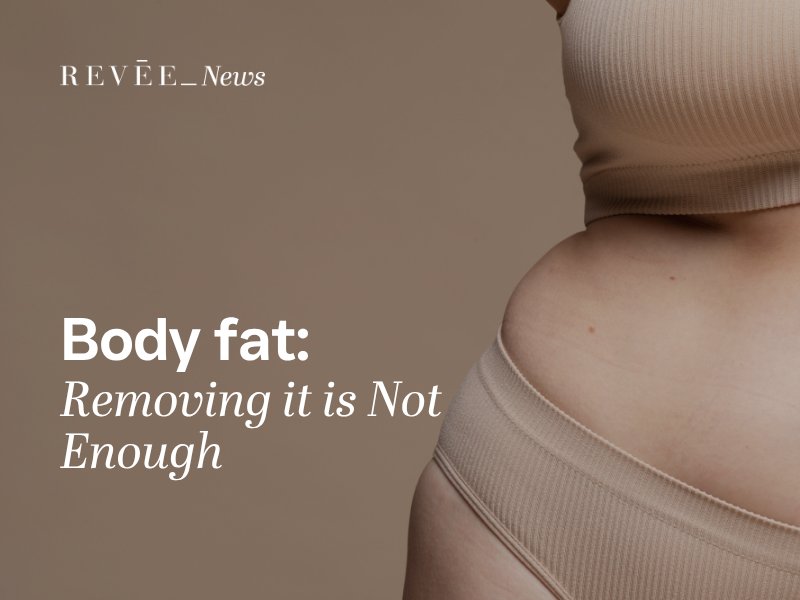
Losing weight means much more than seeing the number on the scales go down. When body fat is significantly reduced, the body’s entire balance changes: the skin, muscles, abdominal wall and distribution of tissues must adapt to a new condition. For this reason, weight loss is often just the first step in a journey that continues with the restoration of function, mobility and quality of life.
In recent years, the spread of bariatric surgery and new pharmaceutical therapies for obesity has increased the number of people who, once they have reached a stable weight, are left dealing with the effects of fat loss: excess skin, loose tissue, diastasis of the rectus muscles, changes to the abdominal wall and difficulties with everyday activities. It is a lesser-known stage, but one that is becoming increasingly central to the treatment journey.
Body Fat Changes the Body Even After Weight Loss
The first change concerns the way the body responds to weight loss. Losing weight does not automatically mean regaining tissue balance: the skin may not be able to fully retract, while deeper structures may lose tone and elasticity.
This is a situation that surgeons are seeing increasingly often. As Professor Vincenzo Vindigni, Professor of Plastic Surgery at the University Hospital of Padua and a member of SICPRE, explains, “we have seen an exponential increase in this type of surgery,” referring to post-bariatric plastic surgery. This growth has been driven both by the increased safety of bariatric surgery and by the growing use of new anti-obesity medications.
The specialist also points out that, regardless of how the weight is lost, «from an objective and functional perspective, these patients have the same problems, the same characteristics and therefore the same types of bodily issues».
The Signs That Go Beyond Aesthetics
The abdomen is one of the areas most affected by fat loss. Excess skin is only part of the problem: weight loss often reveals a weakened abdominal wall, diastasis of the rectus muscles or hernias, which can affect posture, breathing and physical activity.
For Dr Aurelio Cardaci, a reconstructive and aesthetic plastic surgeon, modern abdominoplasty is specifically designed to address these issues.
«The procedure has a functional value because a patient with a weak abdomen and diastasis of the rectus muscles is a patient who develops abdominal herniation under strain», explains Dr. Cardaci, noting that restoring the abdominal wall can also improve digestion, posture and quality of movement.
Weight loss, therefore, does not simply require the removal of excess skin, but a genuine reconstruction of the abdomen’s anatomical balance.
Body Fat and Abdominal Wall Surgery
When diastasis or hernias are present alongside tissue laxity, treatment also involves abdominal wall surgery.
Professor Francesco Coratti, a surgeon at Careggi Hospital in Florence, explains that the aim of reconstruction is to «recreate an adequate abdominal wall that can then restore control of the abdominal muscles», while also treating any hernias that may be present.
Advances in laparoscopic and robotic techniques now make it possible to treat these conditions through increasingly minimally invasive procedures, promoting faster recovery and reducing the impact on the patient.
Alongside the surgical technique, however, patient preparation also plays a fundamental role. Dr Alessandra Saputelli, a general surgeon at San Filippo Neri Hospital, stresses that treatment of the abdominal wall requires a multidisciplinary approach.
«We work with physiotherapists, physiatrists, diabetologists, nutritionists, pulmonologists and cardiologists who follow the patient, enabling us to get them into optimal condition for surgery», she explains, highlighting the importance of preparing patients before surgery to reduce complications and promote recovery.
Body Fat After Weight Loss: The Role of Body Contouring
Once abdominal function has been restored, the process can continue with reshaping other areas of the body affected by weight loss.
This is the field of body contouring, which targets the arms, thighs, breasts and abdomen and now represents an integral part of post-bariatric surgery.
As Professor Valerio Cervelli, Professor of Plastic Surgery at the University of Rome Tor Vergata, explains, «the typical body-contouring patient is someone who has experienced significant weight loss… resulting in excess volume». In many cases, these patients also have diastasis of the rectus muscles, a condition requiring specific treatment to restore the functionality of the abdominal wall as well as the harmony of the body’s contours.
Professor Paolo Persichetti, Director of the Complex Operative Unit and the School of Specialisation in Reconstructive and Aesthetic Plastic Surgery at the University Campus Bio-Medico of Rome, also stresses that these procedures go far beyond aesthetics.
«A patient who returns to a normal weight can live a normal life again without the handicap of pathological obesity. There is a recovery not only in terms of appearance, but also emotionally», he observes, highlighting how body reshaping can also contribute to restoring self-esteem and quality of life.
Body Fat and Recovery: A Journey That Continues After Surgery
The journey, however, does not end in the operating room.
The quality of scar healing, the resumption of physical activity and proper post-operative management are essential parts of the final outcome.

For Agostino Bruno, a specialist in plastic surgery and body contouring, the approach has changed profoundly in recent years.
«The modern concept of abdominoplasty is precisely that of 360-degree body contouring. It is no longer simply about removing excess skin, but about reshaping the body as a whole», he explains. This approach considers the body as a whole and combines surgery with functional recovery, the use of post-operative devices and a gradual return to normal daily activities.
The message emerging from the specialists’ experiences is consistent: body fat is not simply something to be removed. Reducing it profoundly changes the body and, in many cases, requires a reconstructive journey involving a range of different areas of expertise. Today, the success of obesity treatment is measured not only in the number of kilograms lost, but also in the ability to restore patients’ function, wellbeing and quality of life.





Breast Cancer: From Prevention to Treatment

Alzheimer’s and Ambiguous Loss: The Grief of Caring for a Loved One

Orthopedic Surgery, Robotics and Regenerative Medicine: What Changes for Patients

Plastic Surgery Between Innovation and Reconstruction: Bari Hosts the 74th SICPRE National Congress

Vascular Diseases: From Prevention to New Treatments

Regenerative Plastic Surgery: Our Own Tissues Become Treatment

Early Diagnosis and Gene Therapy: The Breakthrough Reshaping the Future of Newborns with SMA

Facelift Surgery: Respecting the Person’s Identity

Your skin is talking to you. Are you listening?

Body Fat: Removing It Is Not Enough

Respiratory Allergies: What Is Changing?

Treating the Wound to Support Surgical Success

Quality, safety, and trust: the value of ISO 13485 certification

Biorevitalization: Beyond the Promises of Creams

Trichology: what your hair can reveal about your health

Lipedema: it’s not enough to look at body weight

Lipoedema: The Unresolved Challenge of Delayed Diagnosis

After weight loss, the body changes twice: the role of plastic surgery in body contouring

Skin cancer: warning signs not to ignore and new treatments that are changing the prognosis
Alzheimer’s and Ambiguous Loss: The Grief of Caring for a Loved One
Biorevitalization: Beyond the Promises of Creams
Trichology: what your hair can reveal about your health
Respiratory Allergies: What Is Changing?
Quality, safety, and trust: the value of ISO 13485 certification
Regenerative Plastic Surgery: Our Own Tissues Become Treatment
Treating the Wound to Support Surgical Success
Body Fat: Removing It Is Not Enough
Facelift Surgery: Respecting the Person’s Identity
Your skin is talking to you. Are you listening?
Plastic Surgery Between Innovation and Reconstruction: Bari Hosts the 74th SICPRE National Congress
Early Diagnosis and Gene Therapy: The Breakthrough Reshaping the Future of Newborns with SMA
Vascular Diseases: From Prevention to New Treatments
Orthopedic Surgery, Robotics and Regenerative Medicine: What Changes for Patients