Medical doctors and Surgeons
Regenerative Plastic Surgery: Our Own Tissues Become Treatment

Using what our own bodies already possess to repair, reconstruct and improve damaged tissues. This is one of the principles behind regenerative plastic surgery, a field that in recent years has expanded the possibilities of reconstructive and aesthetic surgery through the use of adipose tissue, platelet-rich plasma and biomaterials. This approach focuses on the biological potential of tissues and, in some cases, makes it possible to use less invasive procedures than traditional surgery.
Professor Pietro Gentile, Associate Professor of Plastic and Reconstructive Surgery at the University of Rome Tor Vergata, explains the potential, applications and limitations of this field. Gentile is also included among the World’s Top 2% Scientists and has been recognised by the University of Rome Tor Vergata among researchers in the field of Medicine featured in the international ranking. In 2026, he is also among the leading researchers in the AD Scientific Index for research in regenerative plastic surgery.
Regenerative plastic surgery: a new way to repair tissues
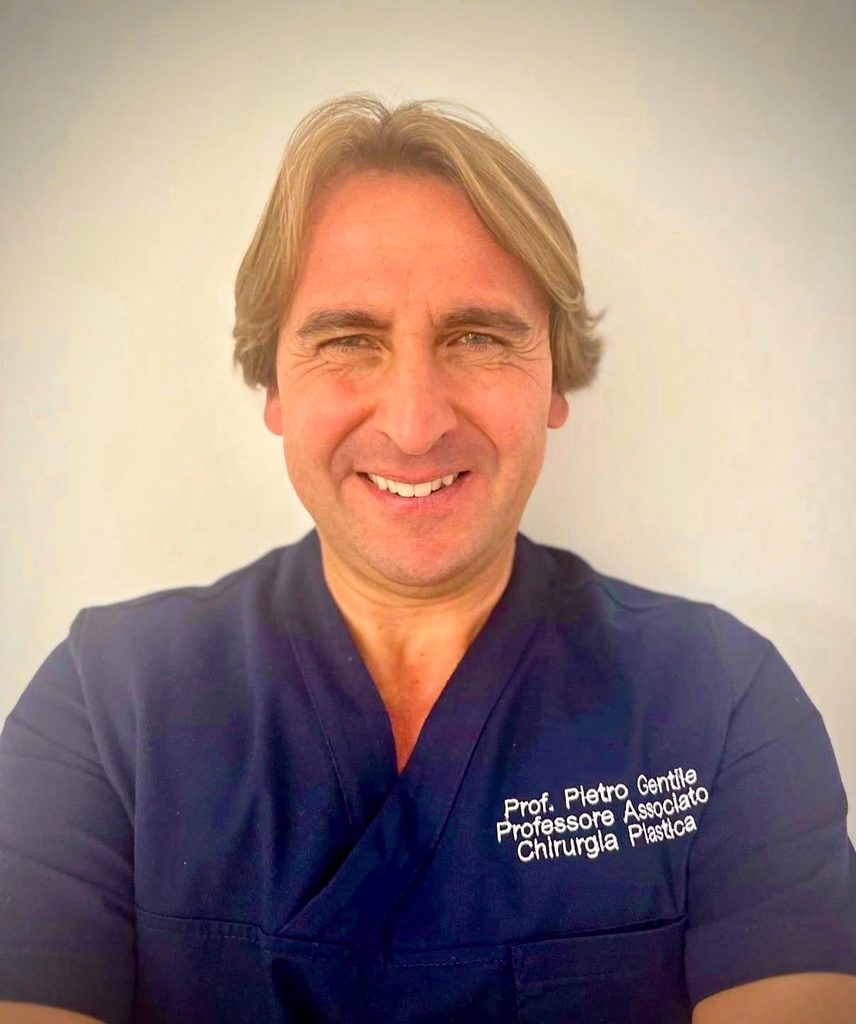
The change introduced by regenerative plastic surgery begins with the possibility of using a patient’s own cells and tissues as part of the surgical process. «Regenerative plastic surgery has essentially introduced the possibility of using one’s own cells and tissues to repair and regenerate tissue loss, or in any case to help people undergo non-invasive or at least minimally invasive procedures that are far less invasive than traditional aesthetic or reconstructive plastic surgery procedures», explains Professor Gentile.
Among the tools available, three play a central role: adipose tissue, platelet-rich plasma (PRP) obtained from the patient’s blood, and biomaterials used, for example, in the treatment of tissue loss and ulcers.
«These three weapons, adipose tissue, platelet-rich plasma and biomaterials, particularly dermal substitutes, represent the three pillars of regenerative plastic surgery», says the Professor, highlighting that these are accompanied by further tools designed to improve the outcomes of both reconstructive and aesthetic procedures.
Adipose tissue: from aesthetic concern to regenerative resource
Fat is one of the most significant examples of the evolution of this field. While it was once considered primarily an inert tissue or an excess to be removed, research has progressively revealed far more complex characteristics.
«Many years ago, adipose tissue was considered an inert tissue, and therefore an aesthetic concern – Gentile explains – In reality, what has emerged over the past 25–26 years, starting from 2000–2001, is that adult stem cells known as adipose-derived stem cells have been identified within adipose tissue».
According to the Professor, these cells represent «one of the most important sources in our bodies for repairing tissues». However, the value of adipose tissue does not depend exclusively on its cellular component, but also on the matrix that makes up the tissue.
Lipofilling: from breast procedures to scar correction
One of the best-known applications of adipose tissue is lipofilling, or the grafting of fat taken from the patient themselves.
In breast surgery, it can be used in both reconstructive and aesthetic procedures. A patient who has undergone the removal of breast cancer, for example, may be a candidate for reconstruction using their own adipose tissue, depending on their clinical pathway and individual characteristics. «This woman may choose, for example, to undergo breast lipofilling to reconstruct the breast», explains Gentile, while pointing out that several procedures may be required and that the patient must have an adequate amount of adipose tissue available.
Lipofilling can also be used to increase breast volume in cases such as asymmetry, tuberous breasts or hypoplasia. In these situations, the available options include implants, the patient’s own fat, or a hybrid technique combining both.
The choice must take into account the characteristics and limitations of the different procedures. One of the main considerations with lipofilling is the reabsorption of the transferred tissue.
«Generally, fat undergoes a reabsorption rate of 40–60% during the first six months. After the first six months, all the fat that has successfully grafted and therefore remains is considered stable and permanent», says Professor Gentile, explaining that this process can be influenced by the grafting and purification technique, the surgeon’s experience, the amount of fat used and the post-operative instructions followed.
Applications are not limited to the breast. «Breast lipofilling is only one of its therapeutic possibilities», Gentile notes, also citing facial rejuvenation, scar treatment and buttock augmentation.
PRP and biomaterials in regenerative plastic surgery
Another area of application involves platelet-rich plasma, or PRP, a non-transfusion blood component obtained from blood. «Platelet-rich plasma can be used, subject to authorisation from the relevant transfusion service, in selected cases considered suitable for the treatment of androgenetic alopecia and alopecia areata», explains Gentile.
However, these procedures require a prior assessment of the patient’s suitability and must be carried out in compliance with the relevant regulations.
Regenerative plastic surgery also includes the use of follicular cells and micrografts containing follicular cells for the treatment of hair thinning, as well as the use of biomaterials and dermal substitutes for tissue loss and lower-limb ulcers.
«Over the past 15 years, regenerative plastic surgery has introduced, in a more concrete way, effective minimally invasive surgical strategies that can clearly represent a valid alternative to the conventional traditional methods used in both reconstructive and aesthetic surgery», the Professor highlights.
The limitations of regenerative plastic surgery
The potential of research must nevertheless contend with limitations that are not exclusively scientific. According to Professor Gentile, one of the main obstacles concerns the regulatory framework and the availability of the facilities needed to develop certain procedures.
«The limitations are primarily legislative in nature», he says. In Italy, as in the rest of Europe, there are precise rules governing the use and manipulation of cells.
One example concerns stem cells derived from adipose tissue. «It is not possible to carry out the expansion of adipose-derived stem cells outside a GMP laboratory», Gentile explains. The acronym refers to Good Manufacturing Practices, the standards required for facilities operating in this field.
According to the Professor, the limited number of dedicated facilities also represents a challenge. «The limitations are mainly of this kind, therefore legislative in nature, because there are clearly restrictions and these restrictions cannot be overcome without the presence of dedicated facilities such as these GMP laboratories», he points out.
The future: could we donate our own adipose tissue?
It is precisely on the boundary between what is possible today and what may become possible tomorrow that part of the research is focused. Among the developments identified by Professor Gentile is the possibility of achieving allogeneic adipose tissue transplantation, that is, using fat from another person.
«Being able to perform an allogeneic transplant for the first time is certainly a challenge: being able to donate one’s own fat to another person and to use another person’s fat», he explains.
This prospect could potentially find applications, for example, in patients with the consequences of very extensive burns, where adipose tissue could contribute to the treatment of scars. «Fat could represent a very useful resource for mitigating scar outcomes, softening scars and improving their aesthetic quality», Gentile explains.
Today, in Italy, it is possible to preserve and store adipose tissue so that it may potentially be reused by the same person, while donation to third parties is not currently permitted. This could represent one of the next steps for regenerative plastic surgery: transforming a tissue that for decades was considered simply something to be removed into a biological resource that could potentially also be used for another patient.
Achieving this will require further research, dedicated facilities and a regulatory framework capable of supporting innovation without compromising safety.








Plastic Surgery Between Innovation and Reconstruction: Bari Hosts the 74th SICPRE National Congress

Vascular Diseases: From Prevention to New Treatments

Regenerative Plastic Surgery: Our Own Tissues Become Treatment

Early Diagnosis and Gene Therapy: The Breakthrough Reshaping the Future of Newborns with SMA

Facelift Surgery: Respecting the Person’s Identity

Your skin is talking to you. Are you listening?

Body Fat: Removing It Is Not Enough

Respiratory Allergies: What Is Changing?

Treating the Wound to Support Surgical Success

Quality, safety, and trust: the value of ISO 13485 certification

Biorevitalization: Beyond the Promises of Creams

Trichology: what your hair can reveal about your health

Lipedema: it’s not enough to look at body weight

Lipoedema: The Unresolved Challenge of Delayed Diagnosis

After weight loss, the body changes twice: the role of plastic surgery in body contouring

Skin cancer: warning signs not to ignore and new treatments that are changing the prognosis

Lipedema and physiotherapy in managing the condition

Mitral Valve: diagnosis and heart surgery for the patient

Cleft Lip and Palate: surgery that changes not just a face, but an entire childhood
Biorevitalization: Beyond the Promises of Creams
Lipoedema: The Unresolved Challenge of Delayed Diagnosis
Trichology: what your hair can reveal about your health
After weight loss, the body changes twice: the role of plastic surgery in body contouring
Respiratory Allergies: What Is Changing?
Lipedema: it’s not enough to look at body weight
Quality, safety, and trust: the value of ISO 13485 certification
Treating the Wound to Support Surgical Success
Body Fat: Removing It Is Not Enough
Regenerative Plastic Surgery: Our Own Tissues Become Treatment
Facelift Surgery: Respecting the Person’s Identity
Your skin is talking to you. Are you listening?
Early Diagnosis and Gene Therapy: The Breakthrough Reshaping the Future of Newborns with SMA
Vascular Diseases: From Prevention to New Treatments